
Citrus County, FL
Roofing Services in Crystal River, FL
Crystal River roofing for repair, replacement, and storm damage in Citrus County. We pull the permit and handle final inspection. (352) 605-0696.
Call (352) 605-0696What Crystal River Weather Actually Does to a Roof
Crystal River sits on low ground at the edge of the Gulf, and that location decides most of what goes wrong with roofs here. Salt air moves inland on the breeze and works on metal first: fasteners, drip edge, valley metal, vent collars, and the flashing around chimneys and skylights. Sun and heat cook asphalt shingles from above while the attic bakes them from below. Summer afternoon storms arrive fast, dump water, and leave. A roof in this town is rarely failing because of one dramatic event. It is usually failing from ten years of ordinary weather that nobody was watching.
Then there is the other kind of day. In September 2024, storm surge from Hurricane Helene flooded Crystal River and the rest of Citrus County. Residents in Flood Zone A saw severe flooding, with reports of up to roughly three feet of water inside buildings. County officials described it as the largest surge in the 137 years of the county's recorded history, and more than 85 rescues were carried out. Surge is a water problem that arrives from below, not through the roof. But the same storm that pushes water into a living room is lifting shingles, tearing ridge caps loose, and driving rain sideways under the edge of a roof that was already tired.
The 2026 Atlantic season is forecast on the quieter side. NOAA's May outlook called for 8 to 14 named storms, 3 to 6 hurricanes, and 1 to 3 major hurricanes. The August update revised that down to 7 to 13 named storms, 2 to 6 hurricanes, and 0 to 2 major hurricanes, with a 75 percent chance of a below normal season attributed to El Nino conditions. That is genuinely good news, and it changes nothing about how a roof should be maintained. A below normal season is a statement about how many storms form, not about where they go. One storm on the wrong track is a full season for the house it hits.
So the practical reading of Crystal River weather is not panic. It is that the roof takes constant low grade wear from salt and sun, and occasionally takes a very bad afternoon. A roof that is in good condition on an average Tuesday is the one that survives the bad afternoon.
Roof Repair and Leak Detection in Crystal River
Most calls we take start the same way. A brown ring on a ceiling, a drip during one specific kind of rain, or a wet spot on the garage floor after a windy night. The hard part of a leak is almost never the repair itself. It is finding the actual entry point, because water does not fall straight down. It lands on the roof, runs along the underside of the deck, follows a rafter, crosses a truss plate, and shows up in a room that has nothing to do with the hole.
Our leak work starts with an on site inspection and a thorough visual examination of the roof. We inspect the attic when it is accessible, looking for daylight coming through, water staining on the decking, and moisture sitting in the insulation. From there we use thermal imaging to identify suspect areas, then press a moisture meter directly against decking, insulation, and framing to get precise moisture readings instead of guesses. When the scan points to a general zone but not to a point, we spray water on specific areas of the roof in a systematic pattern while a second technician monitors the attic from inside. The images and readings become part of your permanent inspection record. There is more detail on roof leak detection and repair and on roof repair.
Repairs on the Gulf side of Citrus County follow their own pattern. Fastener heads corrode. Sealant at pipe boots dries and splits. Ridge vents work loose. Flashing separates where two planes meet. Those are small failures with large consequences, because the decking underneath softens quietly for months before anyone sees a stain on a ceiling.
If the roof is otherwise sound, a repair is the right answer and we will tell you that. If the deck is already spongy across a wide area, patching is spending money to delay a decision you have already made. We would rather show you photos of the deck and let you decide with the same information we have.
There is also a reason to think twice about handling it yourself. In Citrus County, an owner or builder permit for re roofing requires a physical inspection by a county inspector. Photos and a signed self certification do not satisfy it. If the work is going to be inspected in person regardless, doing it yourself buys less than people expect. For an active leak or an opening after a storm, see emergency roof repair.
Roof Replacement for Crystal River's Older Housing Stock
The median home in Crystal River was built in 1988, which puts the typical house here at roughly 38 years old in 2026. About 85 percent of homes are occupied by their owners rather than rented. Those two numbers together explain most of the roofing decisions made in this town. A 38 year old house is on its second or third roof, and the person paying for it is the person sleeping under it. Nobody here is deferring a replacement to make a rental pencil out. They defer it because a roof is a large purchase and nothing looks obviously wrong yet.
The signs that a repair is no longer the honest answer are consistent: shingles shedding granules in quantity, edges curling or cupping across the whole field rather than in one corner, repeat leaks appearing in different places, visible sagging between rafters, and decking that flexes underfoot. On tile roofs, cracked or slipped tiles are often a symptom of underlayment that has reached the end of its life, and the underlayment is the layer actually keeping water out. Our tile roof repairs page covers that case, and total roof replacement covers a full tear off.
What moves the number on a replacement quote is not mysterious, and you should expect to see it broken out. How many layers come off, and what disposal costs. What we find on the deck once it is bare, since rotted sheathing has to be replaced and nobody can price that from the driveway. Roof size, pitch, and complexity, because valleys, dormers, and penetrations take time that a simple rectangle does not. Material choice. Permit and inspection. We put those components in a written proposal so you are reading a breakdown instead of a single lump figure.
Material matters more on this side of the county than it does inland. Shingle roof installation is still the most common choice here and performs well when it is fastened correctly for the wind zone. Metal roofing systems and stone coated steel tile are built around mechanical attachment and resistance to wind driven debris, which counts near the water. The right answer depends on the house, the exposure, and the budget, and we will walk through all three rather than pushing one product.
Permits, Licensing, and the Code Behind a Citrus County Re Roof
Crystal River is in Citrus County, and Citrus County has its own building division, its own inspectors, and its own paperwork. This is not Hernando County. A contractor who only works south of that line does not automatically know how this process runs.
Start with licensing. In Citrus County, roofing contractors must be licensed under Chapter 489, 471, or 481 of the Florida Statutes. Re roofing work has to comply with Florida Statute 553.844 and with the 8th edition of the Florida Building Code, specifically section R903.1 on the residential side and 1503.1 on the commercial side. Those citations are not decoration on a form. They are the standard the inspector checks the work against.
We pull the permit for your job and we conduct the final inspection. That is part of the service, not a task handed back to the homeowner halfway through. You should not be calling the building division to schedule anything, and you should not be the one explaining a code section to an inspector on your own roof.
Owner and builder permits work differently, and it is worth understanding before deciding to run the job yourself. In Citrus County, an owner or builder re roofing permit requires an in person inspection by a county inspector. Photos and self declaration do not satisfy the requirement.
One recent change deserves real care. Florida HB 803, signed in May 2026 and effective July 1, 2026, creates a building permit exemption for single family residential work valued under $7,500. On the surface it sounds like small roof jobs no longer need a permit. Read the exclusions before counting on it. The exemption does not apply to a project located wholly or partly in a flood hazard area, does not apply to structural work, and requires a written request for the exemption. Crystal River has a meaningful amount of low lying ground inside FEMA flood zones, and the city runs its own floodplain management program precisely because of that. For many addresses in this city, the exemption is simply not available, and assuming otherwise is how a job ends up unpermitted and a future sale gets complicated.
Wind Speed, Debris, and How a Roof Gets Fastened Here
Citrus County sits on the transition line between the 110 mph and 120 mph design wind speeds in figure 1609 of the Florida Building Code. Part of the county, the seaward areas measured from the FIRM V zone, is classified as a Wind Borne Debris Region, which adds impact requirements on top of the design wind speed. Crystal River, given where it sits, is exactly the kind of address where those requirements come into play.
In practical terms, the design wind speed drives the fastening schedule: how many nails go in each shingle and where they land, how the starter course is set, how the edge metal is secured, how the underlayment is attached, and which products carry approval for the zone. A roof installed to an inland specification can look identical from the street and behave completely differently in a 100 mph gust, because the difference lives under the surface where nobody looks.
The edge is where wind attacks first. Uplift starts at the perimeter and the corners, gets under the first course, and peels inward from there. That is why edge detailing and the first few feet of a roof deserve more attention on a coastal house than on one ten miles inland in a sheltered subdivision. It is also why a roof that lost a few shingles at the eave after a storm is worth taking seriously instead of writing off as cosmetic.
Material choice follows the same logic. Metal panels and stone coated steel tile are designed around mechanical attachment and impact resistance, which is why they come up often in conversations along this coast. We install both. We also install shingles correctly for this wind zone, which is the more common answer and a perfectly good one. What we will not do is quote a product without telling you how it is being fastened, because the fastening is the part that keeps it on the house.
Our installations meet or exceed code requirements, because the code represents the minimum, not the target.
Storm Damage and Insurance Claims in Citrus County
After a storm, two things decide how a claim goes: what actually happened to the roof, and how well it was documented before anyone started arguing about it. We provide storm damage inspections at no charge, because an accurate picture of the damage from day one is what the entire claim rests on.
The inspection is specific rather than a walk around. We check shingles for wind lift and hail bruising, examine flashing around penetrations and in the valleys, assess soffit and fascia for wind damage, and look for signs of water intrusion in the attic space. Many of our customers ask us to be present during the adjuster's inspection, and we do that. When we meet the adjuster at your property, we point out every area of concern documented in our report so nothing gets overlooked. There is more on insurance claims assistance and on storm damage restoration.
Florida law gives homeowners more ground here than most people realize. Under Florida Statute 627.7011, an insurer cannot refuse to issue or refuse to renew a homeowners policy solely because the roof is less than 15 years old. For a roof that is 15 years or older, the insurer is required to accept an inspection, paid for by the homeowner, showing at least five years of remaining useful life, before it can require roof replacement as a condition of the policy. If you have been told the roof has to go because of its age alone, that statute is worth reading before you write a check.
After a replacement, we recommend scheduling a wind mitigation inspection right away. A new roof built to current Florida Building Code standards will typically qualify for the highest available credits, and nobody applies those credits on your behalf automatically.
Emergency work comes first, though, and the paperwork follows. If the roof is open and water is entering, the claim can wait a few hours. Emergency roof repair covers tarping and stabilization. In the week after emergency tarping, one of our project managers conducts a full roof inspection and builds a detailed repair scope from what it finds, which is also the document that makes the claim conversation concrete instead of a debate about opinions.
My Safe Florida Home and Crystal River Homes
The state's My Safe Florida Home program pays up to $10,000 per home toward wind mitigation improvements, including roof deck fastening and roof to wall connectors. Citrus County is inside the program's coverage area, so Crystal River homeowners can apply.
The eligibility rules are strict, and they are where most applications fail. The home must have a homestead exemption, meaning it is your primary residence rather than an investment or rental property. It must be site built. It must have been permitted before January 1, 2008. And it must pass a wind mitigation inspection performed through the program itself. An inspection you arranged somewhere else does not count, no matter how thorough it was.
Set that 2008 date next to the median build year of 1988 in Crystal River and the overlap is obvious. A large share of the housing here falls inside the eligibility window on age alone, and with roughly 85 percent owner occupancy, most of those homes are somebody's homestead rather than a rental. Program parameters and funding do change between cycles, so confirm the current requirements at mysafeflhome.com before planning around a number.
The timing is worth thinking through. The improvements the program funds are the same things that matter on a coastal roof anyway: the deck held down harder and the roof tied to the walls. If a replacement is already on the horizon, it is worth understanding the program before the work is scheduled rather than after. Our My Safe Florida Home page covers how the roofing side of the work fits with the program.
Gutters, Drainage, and Low Ground
The City of Crystal River runs a floodplain management program and publishes FEMA and flood assistance information for residents, because a meaningful part of the city sits at low elevation inside FEMA flood zones. On ground like that, where roof water goes after it leaves the roof is a real question rather than an afterthought.
A typical house sheds a large volume of water during a Florida afternoon storm. Without gutters, that water lands in a line along the drip edge, splashes back against the wall, and soaks the soil exactly where the foundation is. On low ground with a high water table, that soil has less capacity to absorb it. Gutters do not solve flooding, and no honest roofer will tell you they do. What they do is control the water your own roof produces and move it away from the structure, which is the part you can actually control.
Design matters more than people expect: gutter size, downspout count and placement, and slope. We present the design along with a written estimate that breaks down every component so you know exactly what you are getting. See gutter installation.
Trees and debris clog gutters, and a clogged gutter overflows behind the fascia rather than out the front, which rots the fascia and then works into the roof edge. Gutter protection reduces how often that happens, and gutter cleaning handles what still gets through. We recommend a professional gutter inspection at least once per year, ideally before the rainy stretch rather than during it.
The same logic applies to the roof itself. Regular roof maintenance and a scheduled roof inspection catch the small failures while they are still small, which on a salt exposed roof is most of the job. Roof coating can extend service life on the right substrate, and we will tell you when yours is not the right substrate.
Commercial, Multi Family, and New Construction Roofing
Crystal River is not only single family houses. Commercial buildings, condo and apartment properties, and new construction all need roofs, and they are different jobs with different rules and different failure modes.
On commercial flat roofs, our general recommendation for Central Florida is TPO for general use and PVC for restaurants, chemical environments, or owners who want the longest possible warranty. We handle the entire permitting and inspection process for commercial clients, and permit fees, plan preparation, and inspection coordination are included in project pricing. On a typical commercial project we encounter a deck inspection after tear off, an insulation and fastener inspection before membrane installation, and a final inspection after completion. We provide detailed written proposals that break out every cost component: tear off and disposal, deck repairs, insulation, membrane, flashings, drainage modifications, permits, and warranty. See commercial flat roofing and commercial roofing.
When we design a tapered insulation system for drainage, we make sure the minimum point of the taper still meets or exceeds the code required R value. We work with structural engineers when a project requires it, and we prepare the complete permit documentation package for building department review. Our commercial maintenance programs are structured around the semi annual inspection schedule that most manufacturer warranty programs require, with crews on the roof twice a year examining every seam, flashing, penetration detail, drain, and field area for damage, separation, ponding, or wear.
For apartment and condo properties, multi family roofing deals with what actually makes those jobs hard: occupied buildings, staging, and resident access. For builders, new construction roofing works to the schedule the rest of the trades are running on.
Getting Started in Crystal River
Protech Roofing Services works across Hernando, Citrus, Pasco, Sumter, Polk, Hillsborough, and Pinellas counties, which means we understand the permitting requirements and inspection practices of each building department rather than learning them on your job. Crystal River is served from our headquarters at 9035 Jayson Drive in Brooksville. We are rated 4.9 on Google.
Call (352) 605-0696 to schedule a roof inspection or to talk through a repair, a replacement, or a storm damage claim. Tell us the address and what you are seeing, and we will tell you what we think it is before anyone climbs on anything. If your property is on the inland side of the county, our Inverness roofing page covers that area.
Roofing By Area
Roofing services near Crystal River
FAQ
Frequently Asked Questions
Does Protech Roofing serve Crystal River, FL?
+
Yes. Crystal River and the rest of Citrus County are inside our service area, and we work Crystal River from our headquarters at 9035 Jayson Drive in Brooksville. Citrus is one of the seven Central Florida counties we cover, along with Hernando, Pasco, Sumter, Polk, Hillsborough, and Pinellas, so we know how each building department runs. Call (352) 605-0696 to confirm coverage for your address and schedule a visit.
Do I need a permit to replace my roof in Crystal River?
+
Re roofing in Citrus County is permitted work, and it has to comply with Florida Statute 553.844 and the 8th edition of the Florida Building Code, section R903.1 for residential work. Florida HB 803 created a permit exemption for single family work valued under $7,500 starting July 1, 2026, but it does not apply to a project located wholly or partly in a flood hazard area, does not apply to structural work, and has to be requested in writing. A significant part of Crystal River sits in FEMA flood zones, so do not assume the exemption covers your address. We pull the permit and conduct the final inspection as part of the job.
Can my insurance company make me replace my roof because of its age?
+
Not automatically. Florida Statute 627.7011 prohibits an insurer from refusing to issue or refusing to renew a homeowners policy solely because the roof is less than 15 years old. For a roof 15 years or older, the insurer must accept an inspection paid for by the homeowner showing at least five years of remaining useful life before it can require replacement as a condition of the policy. If you have been told the roof has to go on age alone, that statute is worth reading first.
How do you find a roof leak when there is no obvious damage?
+
We start with an on site inspection of the roof and, when it is accessible, the attic, looking for daylight penetration, staining on the decking, and moisture in the insulation. Then we use thermal imaging to narrow down suspect areas and press a moisture meter against decking, insulation, and framing for precise readings. If that points to a zone rather than a point, we spray water on specific sections in a systematic pattern while a second technician watches the attic from inside. The photos and readings are saved as part of your inspection record.
Can I get help paying for wind protection on my Crystal River home?
+
The My Safe Florida Home program pays up to $10,000 per home for wind mitigation work, including roof deck fastening and roof to wall connectors, and Citrus County is inside the coverage area. To qualify, the home needs a homestead exemption, has to be site built, and has to have been permitted before January 1, 2008, and it must pass a wind mitigation inspection arranged through the program itself. Given that the median Crystal River home was built in 1988, a lot of houses here fall inside that age window. Confirm current program requirements at mysafeflhome.com, since parameters and funding change between cycles.
From the Blog
Stay informed about roofing in Florida.
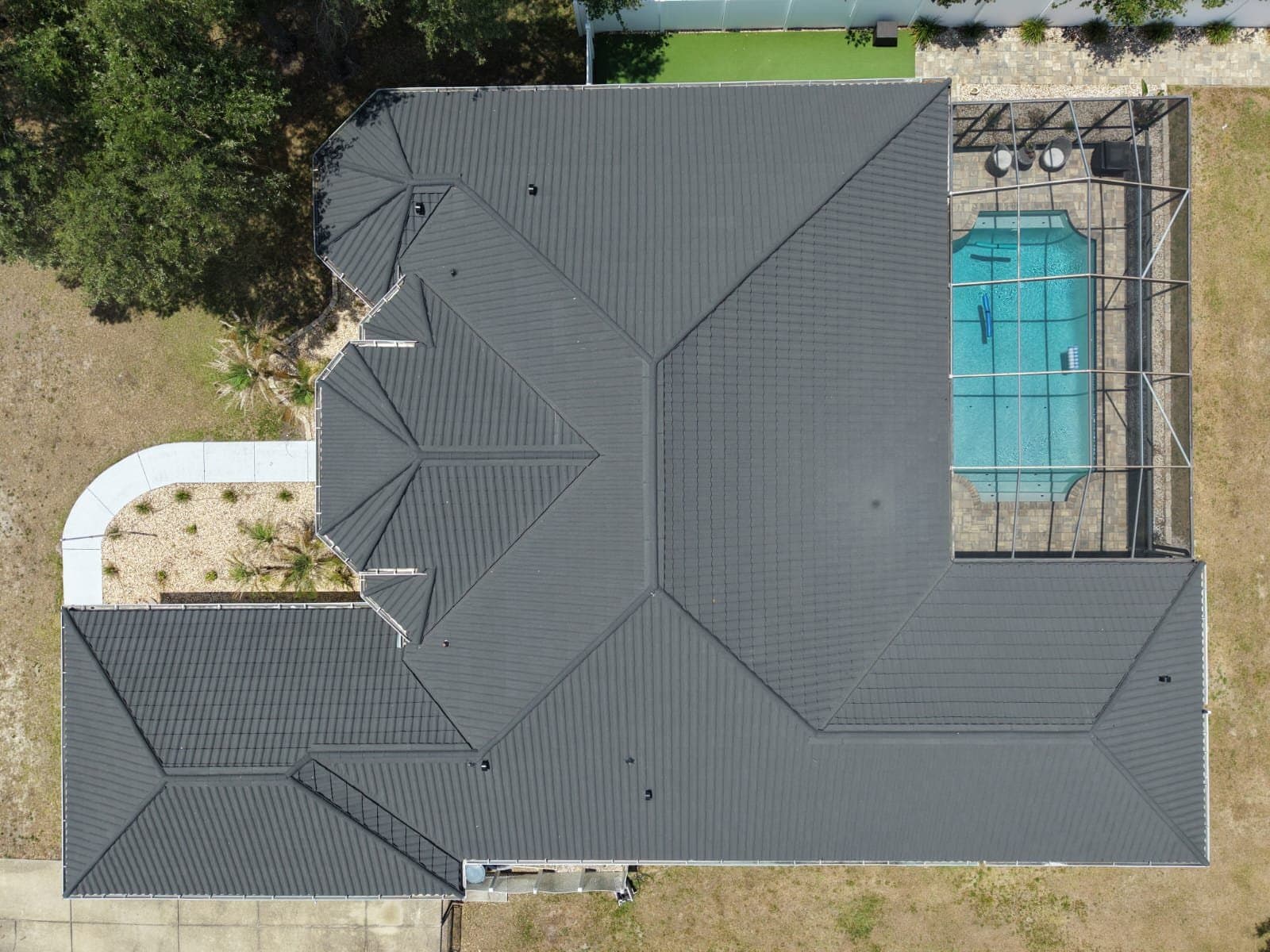
Metal Roof Cost in Florida 2026: Per-Sqft Guide
Metal roofs in Florida run about $8 to $23 per square foot installed, depending on the system. Here is what standing seam, stone coated steel and exposed fastener panels cost, what a typical home pays and how to compare quotes.
Read Article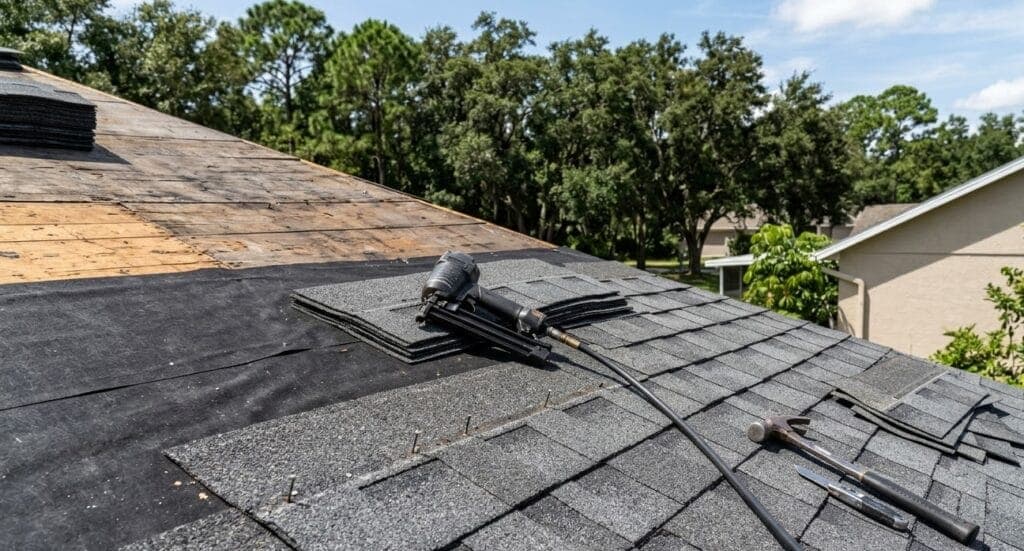
Roofing Warranties in Florida: What Voids Them
A new Florida roof usually carries two warranties: one from the manufacturer for the product and one from the contractor for the installation. Here is what each covers, what quietly voids them and how to keep your coverage.
Read Article
Best Roof Color for Florida Heat: Cool Roofs Explained
Florida test homes show a white shingle saves only 3 to 5 percent on cooling while reflective white metal or tile saves 18 to 26 percent. Here is how to choose a roof color that actually keeps your attic cooler.
Read ArticleReady When You Are
Get your free roof inspection today.
No-pressure, written estimate. Same-week scheduling across Hernando County. Call us now or request a visit online.